Quarter-Tone Harmony/Scales
Artificial quarter-tone scales are entirely possible, and can be theoretically used in the same ways that the major or minor scales can be used. To be specific, in Wyschnegradsky's words...
That is to say, all the notes of the scale are treated as real notes and others as accidentals.
The scales that will be discussed here are exclusively those that repeat (in some form) at the octave, as scales in Western music typically do. Scales that repeat at intervals other than the octave are possible, but will not be discussed here.
Wyschnegradsky's Categorization
Wyschnegradsky categorizes quarter-tone scales into three main groups.
Regular and Semi-regular Scales
The first type, regular scales, divide the octave into equal pieces. In the quarter-tone system, leaving out scales of less than five tones, only four regular scales exist:
- The whole tone scale, six equal steps
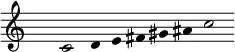
- The three-quarter-tones scale, eight equal steps

- The typical chromatic scale, twelve equal steps

- The quartertonal chromatic scale, twenty-four equal steps

The second category, semi-regular scales, consists of specific scales that are based off an equal division of the octave—into two, three, four, six, or eight equal parts in the quarter-tone system—such that each division is further divided irregularly, but in the same fashion.

For example, the semi-regular scale above is based on the division of the octave into three major thirds, and each of them is further divided into a tetrachord in a pattern of neutral second, semitone, and then neutral second.

This similar semi-regular scale divides the octave into four minor thirds, each of which is further divided in a pattern of quartertone, semitone, quartertone.
Irregular Scales
The third category of scales, irregular scales, consists of any scale which is not regular or semi-regular. This category, however, is so broad that it is in need of organization.
To do so, we use the principles of tetrachords which form our own Western scales. Tetrachords are series of four notes that span a perfect fourth. Two tetrachords combine to form a scale when the second tetrachord starts a perfect fifth above the first. For example, the major scale is constructed by two congruent tetrachords:

The minor scales can be constructed similarly, although the two tetrachords are different:

Already this presents various opportunities for incorporating quartertones.
- Modifying the intervals that comprise tetrachords to include quartertones
- Changing the quanitity of tones within a tetrachord, which produce trichords (three notes), pentachords (five notes), hexachords (six notes), heptachords (seven notes), etc.
- Changing the size of the interval of the outer two tones from a perfect fourth
- Changing how the tetrachords combine to form a scale
This allows for an infinite variety of irregular scales. Here are some examples by Wyshcnegradsky:



The Diatonicized Chromatic Scale
Wyschnegradsky's most well-known piece, his 24 Preludes, revolves around the use of an exceptional irregular scale which he names the diatonicized chromatic scale (l'échelle diatonique diatonisée), consisting of 13 tones:

As highlighted, this scale consists of two heptachords, both of which consist of a series of six semitones followed by a quartertone.
Similarly to how the tones of the diatonic scales (the major scale and its modes) can be produced by a stack of perfect fifths (or fourths when inverted):

The diatonicized chromatic scale is produced by a sequence of stacked superperfect fourths, which approximate the 11:8 frequency ratio (see Harmonic Basis):
