Motivation
Often it is difficult to list every open set of a topology directly. A common strategy is to specify a smaller family of sets and then declare the open sets to be the unions of members of that family. This page develops that idea carefully for bases and subbases (sometimes called semibases).
Definition: Base for a Given Topology
Let  be a topological space. A collection
  is called a base (basis) for
  if every open set
  can be written as a union of elements of
  .
.
Remarks.
- Trivially, is a base for itself.
- If is a base and , then
 . (No choice is needed: for each
  , there is some
  with
with  , hence
  lies in the displayed union.)
Pointwise Characterization
In a topological space , a collection is a base for if and only if for every open set and every point , there exists such that .
Proof. The “only if” direction is immediate because  is a union of elements of . For the converse, set
  . The hypothesis implies every lies in some such
  , hence
  ; therefore
  . The reverse inclusion is obvious, so
  is a union of basis elements. ■
Constructing a Topology from a Base
Let  be any set and a collection of subsets of . We say that is a base on if the following two conditions hold:
- (B1) For each
 , there exists with
  .
.
- (B2) If
 for
for  , then there exists with
  .
.
Given such , define  to be the collection of all
  such that for every there exists with . We call the topology generated by .
Theorem. If satisfies (B1)–(B2), then is a topology on . Moreover, every element of lies in , and every set in is a union of elements of .
Proof. The empty set is vacuously in ; by (B1) the whole set is in . Arbitrary unions are handled pointwise using the definition. For finite intersections, if  with
with  , pick
  such that
  . By (B2) there is with
  , showing
  . The remaining assertions follow directly from the definition. ■
Lemma (Unions of basis elements). If satisfies (B1)–(B2), then  .
.
Minimality. is the intersection of all topologies on that contain .
Let be a topological space. If  has the property that for every open set and every , there exists
  with
with  , then
  is a base for (and
  ).
).
Proof. The pointwise property is precisely the criterion from the first section. ■
Comparing Topologies via Bases
Suppose and  are bases for topologies and
  on the same set . Then the following are equivalent:
- is finer than (that is,
 ).
).
- For each and each with , there exists
 with
with  .
.
(2 ⇒ 1). Let . Fix . Because is a base for , there exists with . By (2), there is such that  . Since this argument works for each , the pointwise (basis) definition of openness for shows
  .
.
- (Note we did not need to choose all
 simultaneously; the definition of openness is pointwise.)*
(1 ⇒ 2). Suppose is finer than . Let and with . Then 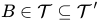 . Because is a base for , there exists with . ∎
Subbases (a.k.a. Semibases)
A collection  of subsets of is a subbasis (many texts say semibase) if
  . The topology generated by is defined to be
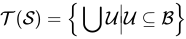 ,
,
where is the collection of all finite intersections of elements of (allowing the empty intersection, which is ). In particular, is a base and 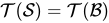 .
.
Proof that is a base. (B1) holds because each lies in some  , hence in a finite intersection containing
  . For (B2), the intersection of two finite intersections of elements of is again a finite intersection of elements of .
Minimality.  is the intersection of all topologies on that contain .
Comparison via subbases
Let  and
and  be subbases generating and , respectively, on . Then is finer than iff for each and each
  with
with  , there exist
 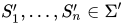 (with
(with  ) such that
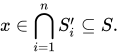
Proof. The base generated by consists of all finite intersections of members of . Apply the basis comparison lemma above with  finite intersections from (in practice each is itself a basis element) and
  finite intersections from . ∎
Examples
- (Standard topology on
 .) The collection of all open intervals
  is a base.
- (Lower limit topology.) The half-open intervals
 (with
(with  ) form a base for the lower limit (or Sorgenfrey) topology on , often denoted
  .
.
- (
 -topology.) Let
  . The family consisting of all open intervals together with all sets of the form
  is a base for a topology on , called the -topology, denoted
  .
.
- (Discrete topology.) For any set , the singletons
 () form a base for the discrete topology.
- (The plane.) In
 , the sets
  (open disks) form a base; so do the axis-parallel open rectangles. Each base generates the usual Euclidean topology, and each refines the other at every point (small rectangles fit inside disks and vice versa).
Further Terminology
- A local base (or neighborhood base) at a point is a collection
 of neighborhoods of such that every neighborhood of contains some member of .
- A space is second countable if it has a countable base. For example, the intervals with rational endpoints form a countable base for the standard topology on .
Exercises
- Show that
 is a base for a topology on and that this topology is the usual one.
- Show that
![{\displaystyle {\mathcal {C}}=\{[a,b]\mid a<b\}}](../_assets_/eb734a37dd21ce173a46342d1cc64c92/08f1ee3b0bd9e495c72430d02a60e7d553c831ae.svg) is not a base for any topology on (identify which base axiom fails).
is not a base for any topology on (identify which base axiom fails).
- Show that
![{\displaystyle {\mathcal {L}}=\{(a,b]\mid a<b\}}](../_assets_/eb734a37dd21ce173a46342d1cc64c92/b56359f99f6852724c26ea04f65a81cd34d58fb9.svg) is a base for a topology on . Compare this topology to the lower limit topology.
is a base for a topology on . Compare this topology to the lower limit topology.
- Let
 . Prove that is a subbasis on and describe explicitly the associated base of finite intersections.
- (Comparing topologies.) Let be the standard topology on ,
 the lower limit topology, and
  the -topology. Show that and are each strictly finer than , but are not comparable to each other.
- (Countable base.) Prove that
 is a base that generates the standard topology on .
- (Minimality.) Let
 be any family of subsets of . Show that the topology generated by equals the intersection of all topologies containing . Do this both when is assumed to be a base and when it is assumed to be a subbasis.
- (Neighborhood bases.) In a metric space, prove that for each the sets
 (
( ) form a countable neighborhood base at .