Axioms used. We work in ZF throughout this page. We do not assume the Axiom of Choice (AC) or the Axiom of Regularity unless explicitly noted. Without AC, not every set need be well-orderable; when we speak of “the” cardinal of a set as an initial ordinal, this is for well-orderable sets. All comparisons “ ” are meaningful in ZF.
Bijections and “same size”
Two sets  have the same cardinality (are the same “size”)
if there is a bijection between them:
have the same cardinality (are the same “size”)
if there is a bijection between them:  iff there exists a one-to-one onto function
  .
.
This is an equivalence relation. For finite sets this recovers ordinary counting. For infinite sets, bijections let us compare sizes without “counting all the way.”
Examples.
 and
and  are equipollent via any bijection, e.g.
  .
. and
and  are equipollent via
  (with
(with  ).
).
Comparing sizes: injections and Cantor–Bernstein
We write  if there is an injection
  .
We write
.
We write  if and
  .
.
Theorem
Proof
Assume there are injections  and
and  .
.
Step 1 (Reduce to the nested case  via equipollence).
Let
via equipollence).
Let ![{\displaystyle B'=f_{2}[B]\subseteq A}](../_assets_/eb734a37dd21ce173a46342d1cc64c92/a2c09c2904ef0ac369ae0436d5e8e231c44e9205.svg) . Since
. Since  is injective, it restricts to a bijection
  with inverse defined by
  whenever
  . Hence
  . Because equipollence is an equivalence relation, it suffices to prove
  ; then transitivity gives
  . Therefore, replacing
  by
by  we may assume from now on that .
Define
 (injective) and
 ![{\displaystyle A_{1}=f[A]\subseteq f_{2}[B]=B\subseteq A}](../_assets_/eb734a37dd21ce173a46342d1cc64c92/94f25710ae9ebb54ed4025c11037f4bf6af39580.svg) .
.
Thus 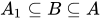 and
and  is a bijection of
  onto its image
  .
.
Step 2 (Iterate  on and ).
Define descending sequences
on and ).
Define descending sequences
![{\displaystyle A_{0}=A,\quad A_{n+1}=f[A_{n}]\quad (n\in \omega )}](../_assets_/eb734a37dd21ce173a46342d1cc64c92/25a5e68e8bf2887a7212659b17b386bc747e2a14.svg) ,
,![{\displaystyle B_{0}=B,\quad B_{n+1}=f[B_{n}]\quad (n\in \omega ).}](../_assets_/eb734a37dd21ce173a46342d1cc64c92/928fc09a8c18afd4b98ed54c3085b03f348bdf28.svg)
Then  and
and  for all
  .
.
Let
 .
.
Then  and
and  .
.
Step 3 (Define the candidate bijection  ).
Set
).
Set
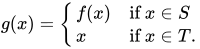
We verify that  is bijective
  .
.
Claim 1 (Points in  already lie in and are fixed).
Since
already lie in and are fixed).
Since 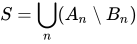 , if
, if  then
then  , hence
  . By definition
  , so
, so ![{\displaystyle g[T]=T\subseteq B}](../_assets_/eb734a37dd21ce173a46342d1cc64c92/068e3edaf889f347c30479fd35383700a9f16138.svg) .
.
Claim 2 (Layers map forward: ![{\displaystyle f[A_{n}\setminus B_{n}]=A_{n+1}\setminus B_{n+1}}](../_assets_/eb734a37dd21ce173a46342d1cc64c92/10ae07eb3e11c9fa180758b4c3324619e1b94b32.svg) ).
Because
).
Because ![{\displaystyle B_{n+1}=f[B_{n}]}](../_assets_/eb734a37dd21ce173a46342d1cc64c92/e7d6b0b1d5f6e8ffe8376359d2ab0f120b5a68a0.svg) , for
, for  we have

Thus  iff
iff  , proving the equality.
Taking unions over ,
![{\displaystyle \displaystyle f[S]=\bigcup _{n<\omega }{\big (}A_{n+1}\setminus B_{n+1}{\big )}=\bigcup _{n\geq 1}(A_{n}\setminus B_{n}).}](../_assets_/eb734a37dd21ce173a46342d1cc64c92/a9506b9271450187969a655a56e5ae62144dca91.svg)
For  ,
,  , hence
 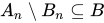 . Also
 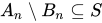 by definition. Therefore
![{\displaystyle f[S]={\Big (}\bigcup _{n\geq 1}(A_{n}\setminus B_{n}){\Big )}=B\cap S=B\setminus T.}](../_assets_/eb734a37dd21ce173a46342d1cc64c92/116a168e73d6f853e8584b09bcef8c0379b62f92.svg)
By the definition of on  , we conclude
![{\displaystyle g[S]=f[S]=B\setminus T.}](../_assets_/eb734a37dd21ce173a46342d1cc64c92/633c4306d313e1e2d66e7381b30c87b0110427a5.svg)
Surjectivity.
Using Claims 1–2,
![{\displaystyle g[A]=g[S]\cup g[T]=(B\setminus T)\cup T=B.}](../_assets_/eb734a37dd21ce173a46342d1cc64c92/04ac6a0fab3e0c21021ce0056c3b6b7abf8c662c.svg)
Injectivity.
Let  .
.
If  and
and  , then
  since
since  is the identity.
If  and , then
  , and injective gives .
If  ,
,  , then
  by Claim 2, while
 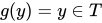 by Claim 1; these are disjoint, so
  . (Symmetrically for ,
  .)
.)
Hence is injective. Together with surjectivity, is a bijection , and therefore .
Cantor’s theorem and the powerset jump
Theorem
(Cantor.) For every set  ,
, 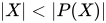 .
.
Proof
Let 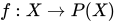 be any function. Define the “diagonal” subset

We show that  is not in the range of . Suppose, for a contradiction, that there exists
  with
with  . Then:
By definition of , we have

But if , this becomes

a contradiction. Hence no such  exists, so
  .
.
Therefore no function  is surjective, so
 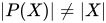 . The map
  is an injection
  , hence
 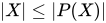 . Combining these, we conclude .
Write  for
for  when
when  .
.
Theorem
If , then  .
.
Proof
 is a bijection.
Thus  for every cardinal “
 ”.
”.
Cardinal arithmetic (well-defined operations)
Given representatives ,  (with
(with  ):
):
- Sum:
 .
.
- Product:
 .
.
- Exponentiation:
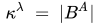 (set of all functions ).
These do not depend on the particular representatives (routine bijection arguments).
Some basic facts (provable in ZF by building the appropriate injections/bijections):
 and
and  are associative and commutative; distributes over .
 ,
,  ,
, 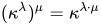 .
.- If
 then
then  . If
. If  then
then  .
.
 ,
,  , and
, and  for
for  .
.
Cardinals as initial ordinals (well-orderable sets)
When a set is well-orderable, its cardinal can be taken to be the least ordinal of that size (an initial ordinal). Write cardinals as  .
.
- Finite cardinals are just the natural numbers:
 .
.
 is the least infinite cardinal.
- A cardinal is a (nonzero) limit cardinal if it is not a successor cardinal.
Theorem
Proof
Step 1 (Collect all well-orderings of subsets of as a set).
Consider the class of all binary relations on , which is the set  by the Axiom of Power Set. Using Separation, form the subset

Thus  is a set.
Step 2 (Take order-types; Replacement).
For each 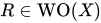 , let
, let  be the unique ordinal isomorphic to
  (where
 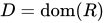 ). The map
  is functional; by the Axiom Schema of Replacement, its range

is a set of ordinals. Intuitively, is the set of all ordinals that inject into (via the isomorphisms to well-ordered subsets of ).
Step 3 (Define  and verify its key property).
Let
and verify its key property).
Let 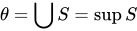 (existence by Union; ordinals are transitive so union is supremum), and let the successor

(existence by Pairing and Union). Then every ordinal  satisfies
  , hence
  , so there is an injection
  . On the other hand
  , so there is no injection
  . Thus is the least ordinal with no injection into .
Step 4 ( is an initial ordinal, hence a cardinal).
Suppose, towards a contradiction, that  for some
  . Since , there is an injection
  (by Step 3). Let
 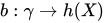 be a bijection. Then
  is injective—contradicting the defining property of . Hence no ordinal is equipollent with ; i.e. is an initial ordinal (a cardinal).
Step 5 (Specialize to  ).
For an ordinal
).
For an ordinal  , every
  injects into (the inclusion map), so
  and therefore
  . Thus there exists a cardinal
  strictly greater than .
Theorem
Proof
Assume for contradiction that is equipollent to some  (i.e. there is a bijection
  ). By the definition of
  , for this
  there exists
  with
with  .
.
Now compare sizes:
Because  (as ordinals), there is an injection
  , so
, so  .
.
Because  , there is an injection
  , so
, so  .
.
Because  (via
(via  ), we get

and by Cantor–Bernstein,  .
.
But is a cardinal (an initial ordinal), so it cannot be equipollent to the strictly smaller ordinal —a contradiction. Therefore no such exists, and is an initial ordinal, i.e. a cardinal.
Alephs and their indexing
Define the increasing enumeration of all initial infinite cardinals:

By abuse of notation in set theory texts, one often also writes  for the initial ordinal of cardinality
  . (In ZF, we use this only for well-orderable sets.)
The canonical well-ordering of 
We define a canonical well-order on pairs of ordinals. For  , set
, set
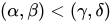 iff either
 , or
, or
 and
and  , or
, or
- ,
 , and
, and  .
.
Intuitively: first compare the larger coordinate, then (if tied) compare the first coordinate, then (if tied) the second.
Theorem
Proof
Linearity. For any two pairs, either their maxima differ (deciding  ), or the maxima agree and then the first coordinates decide unless they agree again, in which case the second coordinates decide. Hence any two pairs are comparable.
Well-foundedness. Let  be nonempty. Consider the set of maxima
  , which has a least element
  since ordinals are well-ordered. Restrict to
  . Among first coordinates in choose the least
  ; among pairs in with first coordinate choose the least second coordinate . Then
  is the least element of .
Initial segment at  . A pair
  satisfies
 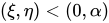 iff
iff 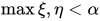 , i.e. iff
  and
and  . Thus the initial segment below is exactly
  .
.
For a pair  , write
 , and define
 ,
,
where  refers to the order type of well-ordered set, i. e. the unique ordinal that bijects with it.
The previous theorem immediately gives:
Theorem
For every ordinal ,  .
.
Proof
By the initial-segment identification,  , hence
  .
.
Remarks.
 is a well-ordered proper class and therefore (uniquely) order-isomorphic to
  . In particular,
  is strictly increasing: if
  , then
  .
.- For each ordinal ,
 because the chain
  has type inside
  (in other words,
  is an increasing function).
Product of alephs via the canonical well-order
We now give a proof that the product of an infinite aleph with itself is itself.
Let  . From the remark above,
  for every .
Theorem
Proof
Assume toward a contradiction that there is a least with  .
.
Since  is an ordinal strictly greater than . By definition of ordering of ordinals, we have
  . By the definition of order-type, there exists an isomorphism
  between and . Let
  . Using "initial segments respects isomorphisms," there is an isomorphism between the initial segment by
  in and the initial segment by in , meaning
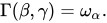
Choose  with
with  and
and  . Then
 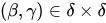 , so the initial segment
  contains a point of rank , and hence

Therefore  . But by minimality of , for every we must have
 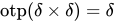 , hence
  . Contradiction.
Thus no such exists, and  for all , i.e.
  .
.
Corollary (addition and multiplication of infinite alephs).
For all infinite alephs,

Using disjoint union and product of well-orders, together with the idempotence  , one shows that both cardinal addition and multiplication collapse to the larger factor on infinite cardinals.
Notes on AC. With AC, every set is well-orderable, “cardinals” are initial ordinals for all sets, and the comparison  linearly orders cardinals. Without AC, we keep all comparisons and constructions above for well-orderable sets, and we refrain from claims that require global well-ordering (e.g., that
  is an aleph).
Worked examples and quick consequences
 is countable (give an explicit bijection).
- The set of all finite sequences of naturals is countable; so is the set of all finite subsets of a countable set.
- For infinite alephs,
 .
.
- By Cantor,
 ; strictly,
  follows from standard projection arguments (see Exercises).
See also


