Laboratory Safety/Using Emergency Equipment
Knowing where all emergency equipment is located is a vital start, but knowing how to use the equipment is just as important.
Types of emergency procedures
Safety shower and eyewash
To use the shower/eyewash, simply pull down the chain. For a special station designed only for eyewash, there is usually a foot petal you stand on to activate it. An uninjured neighbor should assist the person to the shower/eyewash.
Fire blanket

To use the fire blanket, completely cover the flames with the blanket until fire goes out. The fire should be small enough to be covered by the blanket. Otherwise, use the fire extinguisher. Use the fire blanket to cover someone who just used the shower since their cloth would be wet and partially burned.
Fire extinguisher
Before using a fire extinguisher, you should know what class of fire extinguisher it is and if it is appropriate to extinguish the fire you are faced with. There are five main classes of fire, and each fire extinguisher is rated with the classes it can be used against, with the first 3 (A, B, and C) being the most common:[1]
- Class A includes regular combustible fires such as wood, paper, cloth or rubber.
- Class B includes oil based fires such as gasoline and other flammable liquids.
- Class C includes electrical fires.
- Class D includes fires from combustible metals, like lithium.
- Class K (for "kitchen") is limited only to fires from cooking oil.
Some of the most common fire extinguishers are "A-B-C" type extinguishers, which contain a dry chemical or carbon dioxide and are suitable for all three of these classes of fire.
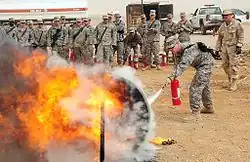
DO NOT USE CLASS A EXTINGUISHER FOR ELECTRICAL FIRES. Class A extinguishers are filled with high pressure water, so there is a risk of electrical shock. Pull off the metal safety pin and aim at the base of the fire, not at the flame itself. You should be trying to put out the source of the fire. The acronym "P-A-S-S" is promoted by some organisations as a means to memorize how to use a fire extinguisher:[2]
- P: Pull the pin,
- A: Aim the nozzle at the base of the fire,
- S: Squeeze the trigger slowly and evenly to dispense the material from the canister, and
- S: Sweep the nozzle across the base of the fire.
Fire extinguishers often have a recoil or kick back, which could be a surprise. Practice, either through using an old extinguisher that is being replaced or taking a fire safety class, is invaluable in a real emergency.
Notes
- ↑ Conroy 2003, pp. 6-7.
- ↑ "P.A.S.S. the Fire Extinguisher". First Alert. Retrieved 8 September 2025.
References
- Conroy, Mark T. (2003). NFPA Guide to Portable Fire Extinguishers. Jones & Bartlett Learning, LLC. ISBN 9780877654780.
- Kennedy, Shelia, and John Palmer. Chemistry Lab Safety Manual. UCSD, 2010. eBook.